Γ

SynBioBeta Speaker

Kexin Huang

Phylo

Co-founder & CEO

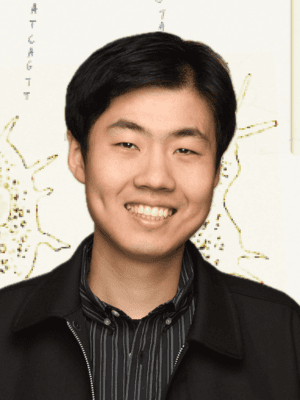
Kexin Huang is the co-founder and CEO of Phylo, the company behind Biomni Lab, the first Integrated Biology Environment where scientists collaborate with AI agents to accelerate scientific discovery. Phylo has raised a $13.5M seed round led by Andreessen Horowitz and Menlo Ventures' Anthology Fund.Before founding Phylo, Kexin was a PhD student in Computer Science at Stanford, advised by Jure Leskovec at the Stanford AI Lab, where he led the Biomni research project that Phylo spun out of. His research focused on building AI systems that produce novel, trustworthy, and interpretable biomedical discoveries — from multi-modal biological modeling to agentic reasoning for automating day-to-day research tasks. He has spent time researching at Genentech, GSK, Pfizer, Dana-Farber, and Rockefeller University.

Sessions Featuring

Kexin

This Year

Breakout Session

4:30 PM

-

5:15 PM

Tools & Tech

Hypothesis Machines: Multi-Agent Systems for Scientific Insight

What happens when AI systems stop being tools and begin acting like collaborators in scientific thought? Multi-agent architectures such as SciAgents and Google’s “AI Co-Scientist” are pioneering hypothesis generation by dividing scientific reasoning into specialized sub-agents: literature retrievers, causal mappers, and graph-based reasoners. Unlike single models, these teams of agents mimic the structure of scientific collaboration itself — brainstorming, critiquing, and refining ideas. In synthetic biology, such systems could propose new gene circuits, uncover hidden regulatory logic, or suggest underexplored protein folds. This session asks: how far should we trust AI-generated hypotheses, and how do we validate them responsibly? With machine-driven insight now on the horizon, the very architecture of discovery may shift — from lone researchers and teams of humans to networks of humans and machines co-creating the future of biology.
Breakout Session

4:30 PM

-

5:15 PM

Tools & Tech

Hypothesis Machines: Multi-Agent Systems for Scientific Insight

What happens when AI systems stop being tools and begin acting like collaborators in scientific thought? Multi-agent architectures such as SciAgents and Google’s “AI Co-Scientist” are pioneering hypothesis generation by dividing scientific reasoning into specialized sub-agents: literature retrievers, causal mappers, and graph-based reasoners. Unlike single models, these teams of agents mimic the structure of scientific collaboration itself — brainstorming, critiquing, and refining ideas. In synthetic biology, such systems could propose new gene circuits, uncover hidden regulatory logic, or suggest underexplored protein folds. This session asks: how far should we trust AI-generated hypotheses, and how do we validate them responsibly? With machine-driven insight now on the horizon, the very architecture of discovery may shift — from lone researchers and teams of humans to networks of humans and machines co-creating the future of biology.
TBD

Session lineup still growing

Featuring

Speaker Coming Soon

Fireside Chat

12:00 AM

-

8:30 AM

Human Health

From Cells to Patients: Solving the Scale Mismatch in Virtual Biology

Drug discovery often measures biology at the cell level while interventions work at the tissue, organ, or whole-patient scale. This mismatch can make accurate cell-level predictions irrelevant in the clinic. This session dives into strategies to bridge that gap: multiscale modeling that nests single-cell dynamics within organ-level simulations, spatial transcriptomics that preserve context, and surrogate models that translate cell-level outputs into clinical biomarkers. Speakers will ask: how do we ensure virtual biology reflects not just what cells do in isolation, but how biology behaves in the real complexity of patients?

Featuring

Speaker Coming Soon

Previous Speakers Include