SynBioBeta Speaker
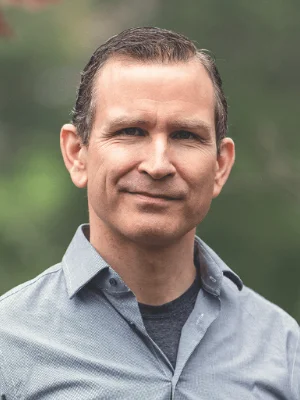
Bruce Friedrich
The Good Food Inst.
Founder & President
Bruce Friedrich is founder and president of the Good Food Institute (GFI), a global network of nonprofit science think tanks with more than 240 full-time team members across affiliates in the U.S., India, Israel, Brazil, APAC (Singapore, Japan, Korea), and Europe. GFI is accelerating the science of plant-based and cultivated meat in order to bolster the global protein supply while protecting our environment and promoting global health.
Bruce’s book Meat will be released Feb 3, 2026. Center for Strategic and International Studies director of global food and water security Caitlin Welsh penned the foreword and writes: “This book explains the imperative to transform our food systems, and lays out a game plan to get us there… Meat is as important as it is enjoyable.”
The book has also earned endorsements from Harvard Medical School genetics professor George Church (“An engaging treatise on using science to make meat far more efficiently… includes fascinating observations in every chapter); The Ministry for the Future author Kim Stanley Robinson (“The topic is crucial, and Friedrich’s presentation is clear, persuasive, and entertaining”); Nobel laureate in economics Michael Kremer (Meat “contributes to an important and timely global conversation”); and more.
SynBioBeta 2026 Tickets are Live
Confirmed Speakers
Sessions Featuring
Bruce
This Year
•
-
Planetary Health
Using Science to Remake Meat: The Next Agricultural Revolution
Meat is one of the world’s most complex biomanufacturing systems—and also one of its least optimized. For 12,000 years, we’ve cycled crops through animals to make meat. Drawing from his new book Meat, Bruce Friedrich contends that advances across science and engineering now make it possible to produce meat far more efficiently, which will reduce meat’s contribution to hunger, climate change, deforestation, antibiotic resistance, and pandemic risk. Most importantly for the success of alternative meats, these new technologies will also improve food security and add to GDP for the nations that lean in. It’s been exactly ten years since the first plant-based burgers were introduced and also exactly ten years since the first cultivated meat companies were incorporated. Bruce will reflect on how far we’ve come, how far we have to go, and what it's going to take to get there. Welcome to the next agricultural revolution—courtesy of science.
Purchase Pass
•
-
Planetary Health
Using Science to Remake Meat: The Next Agricultural Revolution
Meat is one of the world’s most complex biomanufacturing systems—and also one of its least optimized. For 12,000 years, we’ve cycled crops through animals to make meat. Drawing from his new book Meat, Bruce Friedrich contends that advances across science and engineering now make it possible to produce meat far more efficiently, which will reduce meat’s contribution to hunger, climate change, deforestation, antibiotic resistance, and pandemic risk. Most importantly for the success of alternative meats, these new technologies will also improve food security and add to GDP for the nations that lean in. It’s been exactly ten years since the first plant-based burgers were introduced and also exactly ten years since the first cultivated meat companies were incorporated. Bruce will reflect on how far we’ve come, how far we have to go, and what it's going to take to get there. Welcome to the next agricultural revolution—courtesy of science.
Purchase Pass
Session lineup still growing
Purchase Pass
Featuring
Speaker Coming Soon
•
-
Human Health
From Cells to Patients: Solving the Scale Mismatch in Virtual Biology
Drug discovery often measures biology at the cell level while interventions work at the tissue, organ, or whole-patient scale. This mismatch can make accurate cell-level predictions irrelevant in the clinic. This session dives into strategies to bridge that gap: multiscale modeling that nests single-cell dynamics within organ-level simulations, spatial transcriptomics that preserve context, and surrogate models that translate cell-level outputs into clinical biomarkers. Speakers will ask: how do we ensure virtual biology reflects not just what cells do in isolation, but how biology behaves in the real complexity of patients?
Purchase Pass
Featuring
Speaker Coming Soon