Γ

SynBioBeta Speaker

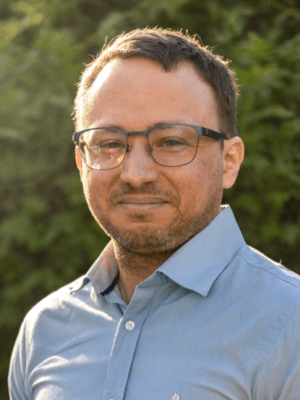
Damien Michelon

iMEAN

Scientific BD

Damien MICHELON, PhD is a Scientific Business Developer specializing in the translation of physics and mathematics based approaches into actionable solutions in the Life Sciences. His work sits at the interface of systems biology, microbiology, and mechanistic modeling, with a strong focus on understanding how biological behavior emerges across scales—from molecules and metabolic networks to cells, populations, and ecosystems.With more than 15 years of experience in life sciences, and passionate about interdisciplinary innovation including a rewarding entrepreneurial journey, Damien MICHELON, PhD holds a PhD in Biochemical Microbiology from the University of Burgundy (France), where his research focused on redox potential modulation driven by lactic acid bacteria and its impact on microbial physiology.Following his PhD, Damien spent more than five years at a European Laboratory for Food Safety as a Scientific Project Manager, leading research and method development programs based on whole genome sequencing to improve Listeria monocytogenes surveillance and epidemiological monitoring. His role included coordinating scientific networks and supporting the implementation of genomic tools for food safety operations.Damien then co founded a startup in phytoremediation, where he was responsible for scientific strategy as well as business development activities. He later joined TWB (Toulouse White Biotechnology) as a Startup Partnership Manager, supporting early stage biotech companies in structuring R&D programs and industrial collaborations.

Sessions Featuring

Damien

This Year

Breakout Session

4:30 PM

-

5:15 PM

Tools & Tech

The Physics of Life: Scaling Biology from Molecules to Cells

Cells are often described as bags of chemistry—but they are better understood as finely tuned physical systems. Within each one, DNA is packed into nanoscopic volumes, enzymes race at turnover rates rivaling jet engines, and molecular collisions happen billions of times per second. This session explores the cell as a physical object—its limits of size, speed, and efficiency. How fast can information move from genome to protein? How does diffusion constrain cell size and shape? How do energy flows through metabolism define what life can and cannot do? By examining the physics that underpins biology, this session challenges us to see cells not as mysterious black boxes, but as programmable systems operating under universal rules. This perspective may hold the key to engineering biology with the same rigor as physics and computer science.
Breakout Session

4:30 PM

-

5:15 PM

Tools & Tech

The Physics of Life: Scaling Biology from Molecules to Cells

Cells are often described as bags of chemistry—but they are better understood as finely tuned physical systems. Within each one, DNA is packed into nanoscopic volumes, enzymes race at turnover rates rivaling jet engines, and molecular collisions happen billions of times per second. This session explores the cell as a physical object—its limits of size, speed, and efficiency. How fast can information move from genome to protein? How does diffusion constrain cell size and shape? How do energy flows through metabolism define what life can and cannot do? By examining the physics that underpins biology, this session challenges us to see cells not as mysterious black boxes, but as programmable systems operating under universal rules. This perspective may hold the key to engineering biology with the same rigor as physics and computer science.

TBD

Session lineup still growing

Featuring

Speaker Coming Soon

Fireside Chat

12:00 AM

-

8:30 AM

Human Health

From Cells to Patients: Solving the Scale Mismatch in Virtual Biology

Drug discovery often measures biology at the cell level while interventions work at the tissue, organ, or whole-patient scale. This mismatch can make accurate cell-level predictions irrelevant in the clinic. This session dives into strategies to bridge that gap: multiscale modeling that nests single-cell dynamics within organ-level simulations, spatial transcriptomics that preserve context, and surrogate models that translate cell-level outputs into clinical biomarkers. Speakers will ask: how do we ensure virtual biology reflects not just what cells do in isolation, but how biology behaves in the real complexity of patients?

Featuring

Speaker Coming Soon

Previous Speakers Include